
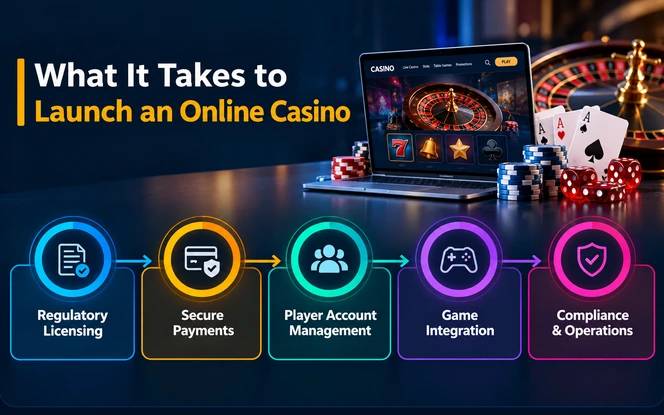
Starting an online casino requires coordinated decisions across licensing, technology, payments, games, compliance and operations. For example, regulatory rules shape the platform, while payment availability affects market viability. In addition, delayed certification or supplier approval can block go-live.
This guide gives operators a practical route from market assessment to launch approval and the first 90 days of operation. It also explains the costs, responsibilities and evidence needed to launch and run the business.
Key Takeaways
- 01Validate the market firstConfirm legal access and commercial viability before selecting technology.
- 02Match the model to capabilityChoose control and responsibility the operator can sustain.
- 03Test failure scenariosAssess operational readiness, not only the happy path.
- 04Stabilise before scalingUse the first 90 days to diagnose and improve the operation.
The Online Casino Launch Roadmap
An online casino needs both regulatory approval and a working operation. First, define the target market, licence route and delivery model. Then map player accounts, payments and games, and assign owners for compliance, risk, support and technology.
Several workstreams can progress in parallel. However, each needs a clear owner, evidence of readiness and a list of blockers. Therefore, update the launch plan whenever a key dependency slips.
A Seven-Stage Launch Sequence
- Validate the market and regulatory path: confirm legal access, product restrictions, licence requirements and commercial viability.
- Choose the delivery and operating model: decide which responsibilities remain with the operator and which belong to providers.
- Design the player journey and technology stack: connect accounts, payments, games, compliance controls, reporting and administration.
- Configure payments, games and suppliers: onboard providers, complete integrations and plan for service failures.
- Build the commercial plan, budget and team: model unit economics, fund the first year and assign accountability.
- Test operational readiness: validate complete journeys, exception handling, security, reporting and launch evidence.
- Manage the first 90 days: stabilise the operation before scaling acquisition and product changes.
How Long Does It Take to Launch an Online Casino?
There is no universal timeline. For example, licensing and banking may overlap with platform setup and PSP onboarding. Recruitment, supplier approval and certification can also run in parallel. However, one unresolved dependency can still delay launch.
As one regulatory reference point, the UK Gambling Commission currently lists 16 weeks for an operating-licence application. However, the timescale assumes a complete application. Complexity, suitability checks, demand and related reviews may affect the decision. Therefore, treat this as a licensing reference rather than a complete launch schedule.
1. Validate the Market and Regulatory Path
Market selection determines the legal, technical and commercial conditions of the launch. Therefore, check the product, payments, suppliers and acquisition channels before choosing a platform. Also confirm that the expected revenue can cover the operating costs.
Regulatory Accessibility
Identify the relevant regulator, licence category, entity requirements, product restrictions, advertising rules, player-protection obligations and technical standards. However, requirements vary significantly between markets. Great Britain, for example, has a remote-gambling framework administered by the UK Gambling Commission. By contrast, Australia shows why market assessment must come first: the Interactive Gambling Act 2001 prohibits specified online services, including online casinos.
Commercial Viability
Model licence and tax costs alongside payments, games, compliance, staffing, marketing, support and working capital. In addition, confirm that the planned structure supports suitable payment methods, currencies, PSPs, games and acquisition routes.
Market-entry test: the assessment should answer whether this specific casino model is legally accessible, operationally supportable and commercially viable in the target market.
Licensing and Corporate Structure
Settle the operating entity, ownership structure and key individuals early. For example, applications may require business plans, financial records and evidence of funding sources. They may also need AML policies, player-protection controls, KYC procedures, system details and supplier information.
Use the compliance and licensing responsibilities in the operating model as the starting checklist, then obtain jurisdiction-specific legal and regulatory advice.
Technical Testing and Ongoing Compliance
Regulatory obligations may extend to technology, security, games, reporting, testing and certification. The UK Gambling Commission’s current Remote Gambling and Software Technical Standards, for example, apply to relevant gambling-software and remote-operating licence holders. Therefore, identify the required tests early, as they may affect the launch date.
A licence also creates ongoing duties. For example, operators may need regular reports, AML reviews, player-protection checks and security audits. Therefore, include the people and budget needed to maintain compliance.
2. Choose the Delivery and Operating Model
The delivery model affects launch speed, control, integrations, staffing and reliance on suppliers. However, providers do not use these labels in the same way. Therefore, compare the licence structure, technology rights, data access, services and contract terms behind each offer.
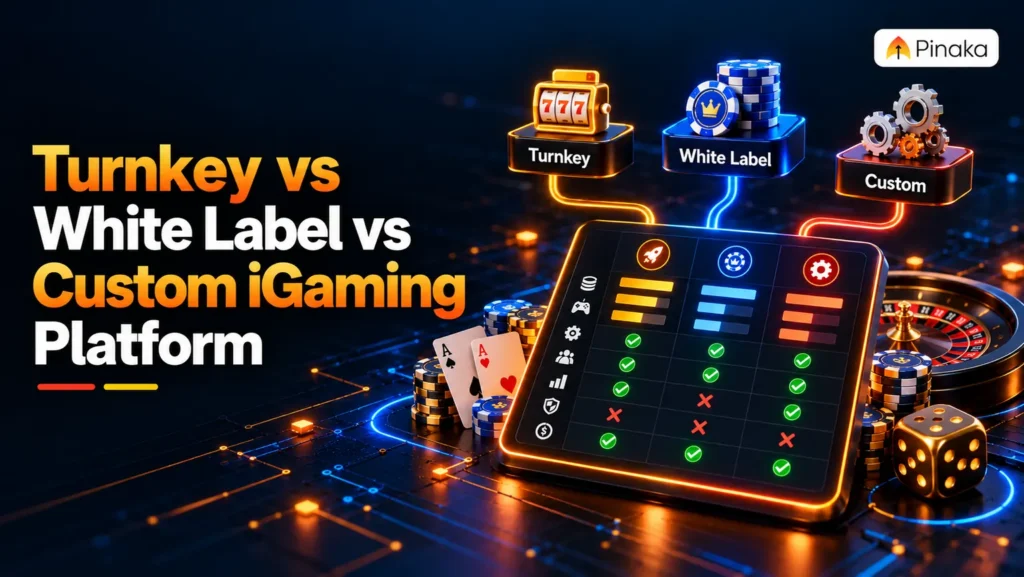
| Model | Typical Launch Profile | Operator Control | Operator-Side Responsibility |
|---|---|---|---|
| White label | Provider-led route designed for faster market entry | Usually lower, subject to contract and architecture | Lower to medium, depending on the regulated and commercial structure |
| Turnkey | Configured platform with established core systems and integrations | Medium to high, depending on platform access and configuration | Medium to high, often including licensing and operations |
| Custom | Bespoke build for differentiated requirements | Potentially high, if rights and access are contractually secured | High across product, engineering, security, testing and maintenance |
| Hybrid | Provider platform combined with custom modules or integrations | Varies by component | Shared between operator and providers |
Where requirements differ by component, use a build, buy, integrate or combine assessment instead of forcing the entire technology stack into one delivery route.
Match Control to Internal Capability
Choosing the right iGaming solution requires matching the model to the target market, time-to-market requirement, product differentiation, integration needs and the responsibilities the business can realistically sustain. However, more control also brings more responsibility. For example, define who owns product decisions, releases, security, suppliers and incident response.
Regulatory responsibility: using a third-party platform or managed service does not automatically remove the responsibilities assigned to the licensed entity or other regulated participants.
3. Design the Player Journey and Technology Stack
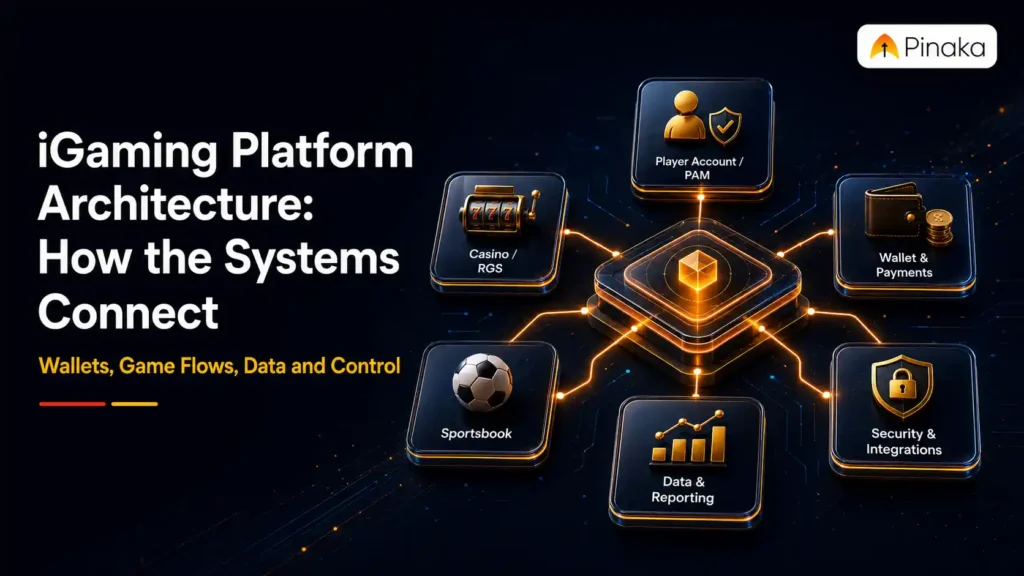
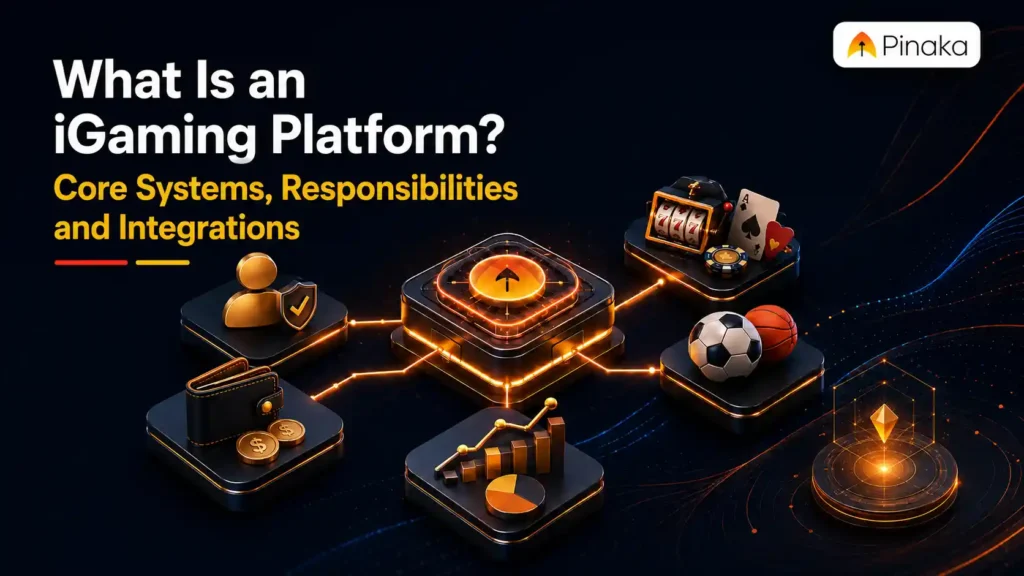
The core responsibilities of an iGaming platform connect player accounts, payments, games, identity verification, risk controls, player protection, reporting and administration. Therefore, map the full player journey before implementation. Each player action, system state and exception needs a clear outcome and owner.
Map the Complete Player Lifecycle
- Registration: required information, eligibility checks and consent.
- Verification: identity, age, location and risk checks required before permitted activity.
- Deposits: how successful, pending, failed and reversed transactions affect the wallet.
- Gambling activity: account states, limits, exclusions, restrictions and risk controls governing game access.
- Withdrawals: approval conditions, holds, reviews, settlement and communication.
- Review and support: responsibility for restricted accounts, disputes, interventions and escalation.
Resolve Conflicting Account and Transaction States
Separate transaction status from account eligibility. For example, a successful deposit does not automatically allow the player to gamble. Likewise, identity verification does not override exclusions or other age, location, fraud and player-protection controls.
Define what happens to funds when an account becomes restricted, including permitted holds, refunds, withdrawals and reviews. A clear iGaming platform architecture should identify the authoritative record, money flow and failure-handling process before launch rather than leaving these states for manual resolution after go-live.
Confirm Platform Control, Data Access and Integrations
Assess the casino platform by operational readiness, market fit, supplier coverage and the control retained after launch. In addition, check API access, report detail, data exports and staff permissions. Finally, confirm who maintains integrations and how the operator can replace a supplier or migrate the platform.
4. Configure Payments, Games and Suppliers
Payments and games are core operating dependencies. First, select providers that support the target market. Then connect them to player accounts and define the response to failed transactions, games, APIs or supplier services.
Select Payment Methods and PSPs
Choose payment methods according to market coverage, player preferences, gambling acceptance, currencies, approval rates, costs, settlement times, withdrawal support, fraud controls, chargebacks, reporting and business continuity.

Manage Transaction States and Reconciliation
The cashier should distinguish successful, pending, failed, reversed and disputed transactions. In addition, set rules for wallet updates, retries, duplicates, refunds, chargebacks and withdrawal holds.
Finance teams should reconcile PSP, cashier, wallet, bank and internal records. Also include settlement timing and reserves when planning working capital.
Build the Opening Game Portfolio
A new casino needs games that fit its market and audience. In addition, the content must have the required approvals and work with the wallet. Compare aggregators, direct suppliers and a mixed approach based on testing, reporting, support and commercial terms.
Plan for Provider Failure
Define how games and payments are monitored, restricted, removed, retried or replaced during outages, certification failures, unstable APIs or commercial changes. Also agree who communicates with players and suppliers. Keep the evidence needed for reconciliation, support and compliance reviews.
5. Build the Commercial Plan, Budget and Team
The commercial model should connect acquisition with player economics and operational cost. Therefore, evaluate the full player journey. Include registration, verification, first deposits, repeat activity, revenue, deductions, support and retention.
Model GGR, NGR and Player Economics
GGR (Gross Gaming Revenue) commonly means wagers minus player winnings. However, check the definition used by the regulator or agreement.
NGR (Net Gaming Revenue) means GGR after specified deductions. For example, these may include bonuses, taxes, payment costs and game fees. Therefore, define each measure before using it in forecasts or supplier agreements.
- Traffic, acquisition sources, media spend and acquisition cost.
- Registration, verification and first-deposit conversion.
- Active players, deposits, withdrawals and gaming activity.
- GGR, NGR, contribution and the deductions included in each measure.
- Retention, repeat activity, churn and player lifetime value.
Budget for Launch and the First Year
| Cost Area | Timing | Primary Cost Drivers |
|---|---|---|
| Legal and licensing | Upfront and recurring | Jurisdiction, entity structure, application complexity and renewals |
| Platform and implementation | Upfront and recurring | Delivery model, configuration, customisation, hosting and support |
| Payments and games | Recurring and variable | Transaction pricing, settlements, chargebacks, supplier and aggregator terms |
| Compliance and testing | Upfront and recurring | Certification, audits, security, monitoring and reporting |
| Internal team | Recurring | Operating model, seniority, locations and outsourced services |
| Marketing and working capital | Pre- and post-launch | Acquisition plan, bonuses, settlement cycles, reserves and runway |
| Contingency | Throughout | Delays, retesting, supplier changes and unexpected integration work |
Separate launch funding from the cash needed to run the business while revenue and settlements stabilise. For example, salaries and supplier costs may fall due before funds arrive. Therefore, budget beyond regulatory fees and platform setup.
Assign Operator-Side Accountability
| Area | Before Launch | After Launch |
|---|---|---|
| Compliance and AML | Licensing, policies, risk assessment and controls | Monitoring, reviews, reporting and regulatory change |
| Player protection | Control design, procedures and testing | Monitoring, interventions and evidence |
| Payments and finance | PSP onboarding, cashier tests, banking and budget | Reconciliation, settlement, failures and reporting |
| Product and technology | Requirements, integrations, security and acceptance | Releases, maintenance, incidents and improvement |
| Operations and support | Training, workflows and escalation design | Player support, exceptions and incident response |
| Suppliers and marketing | Contracts, onboarding and campaign setup | Performance, acquisition, retention and optimisation |
Where a jurisdiction requires responsible officers, qualified personnel or designated compliance functions, include them in the operating structure. In addition, identify who can make decisions and resolve exceptions for every critical process.
6. Test Operational Readiness and Make the Launch Decision
A working happy path is only the start of testing. In addition, check player journeys, integrations, operating procedures and failures across accounts, payments, games and suppliers.
Test the Complete Operation
- Players and accounts: registration, age and identity checks, duplicate or restricted accounts, exclusions, closure, recovery, limits and permitted reinstatement.
- Payments: successful and failed deposits, pending transactions, timeouts, duplicates, reversals, refunds, withdrawals, chargebacks, reconciliation differences and PSP outages.
- Games: launch, wallet communication, interrupted sessions, incorrect availability, bonus interaction, supplier outages and game removal.
- Operations: support escalation, compliance review, fraud alerts, player restrictions, reporting, audit logs, permissions, incidents, backups and recovery.
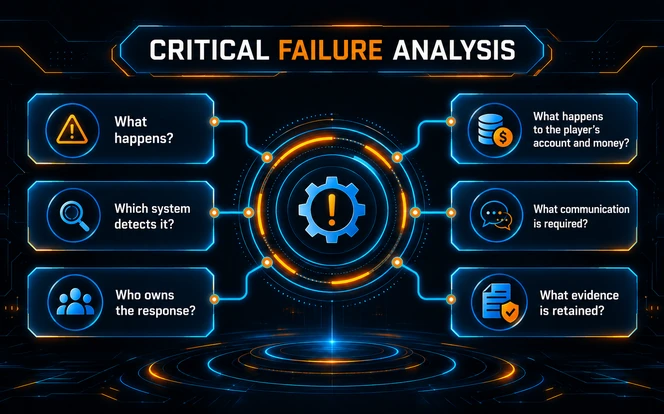
Ask Six Questions for Every Critical Failure
- What happens?
- Which system detects it?
- Who owns the response?
- How does the failure affect the player’s account and money?
- When and how should the team communicate?
- Which evidence should the team retain?
Use an Evidence-Based Go/No-Go Gate
Base the final decision on evidence. For example, use approvals, test results, configuration records and supplier confirmations to support each readiness status. Reconciliations, audit reports and training records can also show whether the team is ready.
| Area | Accountable Owner | Required Evidence | Launch Blocker |
|---|---|---|---|
| Regulatory | Compliance | Licence or approval evidence | Yes |
| Payments | Payments and Finance | PSP approval, transaction tests and reconciliation | Yes |
| Technology | Product and Technology | Production-readiness and security evidence | Yes |
| Games | Product and Suppliers | Approved content and testing evidence | Yes |
| Player protection | Compliance and Product | Controls and interventions tested | Yes |
| Operations | Operations | Support, escalation and incident procedures | Yes |
If a critical blocker remains, delay launch, reduce scope or resolve the dependency. Only then should the team approve go-live.
7. Manage the First 90 Days After Launch
Go-live begins operational optimisation. First, stabilise the operation. Then diagnose problems and make controlled improvements. As the operation grows, review how iGaming technology needs change from launch to migration so that proven operational constraints—not hypothetical features—drive the next investment.
Days 1–30: Stabilise
First, prioritise reliability. Monitor payment failures, game errors, registration and KYC problems, withdrawals, support demand and fraud alerts. Meanwhile, track restrictions and incidents. Scale acquisition only when the operation is stable.
Days 31–60: Diagnose
Next, use operating data to find where players leave and costs rise. Review verification, first deposits, payment approval, withdrawals and game performance. Also check acquisition, bonus abuse, fraud, support demand and retention. Before acting, separate product, operational and commercial problems.
Days 61–90: Improve
Finally, use the first 60 days of evidence to improve payments, onboarding, game discovery and CRM. Also review promotions, fraud controls, support, acquisition and retention. Track growth alongside operational health through conversion, payment performance, support demand, revenue, costs and repeat activity.
Where Pinaka.games Fits
Pinaka.games provides modular and scalable iGaming technology for operators launching, integrating or upgrading casino operations. For example, its services include white-label and turnkey delivery, casino game integration, payment infrastructure, licensing strategy and technical support.
Therefore, define the setup around the target jurisdiction, integrations, operating duties, team capability and product strategy. Then agree how technology, suppliers and operator responsibilities will work together.
Conclusion
Starting an online casino requires a clear plan across regulation, technology and operations. First, confirm the market and regulatory route. Then choose a delivery model, platform, payment setup, suppliers, budget and team that the business can support.
Before accepting players, require evidence that licensing, payments, player journeys, games, security, reporting, procedures and player-protection controls are ready. Finally, stabilise the operation after go-live before increasing acquisition or adding complexity.
Frequently Asked Questions
There is no universal launch cost. For example, the budget depends on the market, delivery model, platform scope, integrations and staffing.
Payments, games, testing, marketing and working capital also affect the total. Therefore, separate setup costs from recurring, variable and contingency costs, then model the first year.
The operation needs the permissions required in every market it serves. However, your company’s licence requirements depend on the jurisdiction and business structure. Some white-label arrangements use a provider-led licensed structure.
By contrast, many turnkey or custom arrangements require the operator’s own licence. Therefore, obtain local legal advice before accepting players.
There is no standard launch timeline. For example, licensing, banking, PSP onboarding and platform setup may run in parallel.
However, a delay in supplier approval, recruitment or testing can still block go-live. As one reference point, the UK Gambling Commission currently lists 16 weeks for an operating-licence application, subject to application quality and complexity.
Choose white-label, turnkey, custom or hybrid delivery based on market access, control, launch speed, team capability, integrations and total costs. However, providers use these labels differently.
Therefore, compare the actual licence structure, data rights, duties, services and contract terms behind each offer.
An online casino typically needs player accounts, payments, wallet functions, games and identity checks. In addition, it needs AML and fraud controls, player-protection tools, CRM, reporting, administration and security monitoring.
These systems must also share consistent account, transaction and restriction states.
First, check market coverage, gambling support, payment methods, currencies and withdrawal options. Then compare approval rates, settlement times, costs, fraud controls and chargeback handling.
Also review reporting, reconciliation and continuity. Finally, agree who maintains the integration and handles transactions during an outage or migration.
An aggregator can connect multiple game suppliers through fewer integrations and a more central commercial relationship. However, compare that convenience with market approval, testing, wallet compatibility, reporting and costs.
Also assess direct-supplier options and reliance on the aggregator.
Test the full player and operational journey, from registration and identity checks to payments, games and withdrawals. In addition, test restrictions, player protection, reporting, staff permissions, security and recovery.
For example, include PSP outages, duplicate transactions, interrupted games, supplier failures and reconciliation differences.